
About
Daroji Sloth Bear Sanctuary was created for the protection of the Indian sloth bear. The Ballari district website calls it the only sanctuary in North Karnataka and places it about 15 km from Hampi, a World Heritage Site. It lies about 65 km from Ballari and 20 km from Hosapete. The area between Daroji in Sandur taluk and Ramasagar of Hospet taluk is home to numerous sloth bears.
In October 1994, the Government of Karnataka declared 5587.30 hectares of the Bilikallu Forest Reserve as Daroji Bear Sanctuary. The sanctuary lies between 15°14′ and 15°17′ N latitude and 76°31′ and 76°40′ E longitude.
Landscape and Wildlife
At the time of the declaration, the forest had little more than barren stony hillocks and thorny trees. According to the Ballari district website, the efforts of the forest staff and the support of surrounding villagers have since turned it into a green forest with local flora and fauna.
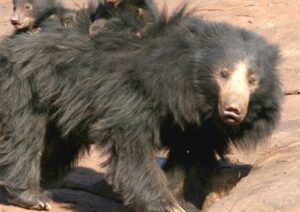
The sanctuary’s flagship species is the Indian sloth bear (Melursus ursinus), known locally as karadi. The district website estimates that about 120 sloth bears live in the sanctuary, sheltering in the caves of the rocky hillocks. Other animals recorded include leopards, hyenas, jackals, wild boar, porcupines, pangolins, star tortoises, monitor lizards, mongooses, peafowl, partridges, painted spurfowl and quails. A preliminary survey identified about 90 species of birds and 27 species of butterflies.
About the Sloth Bear
- Sloth bears live in open scrub forest with rock outcrops, tumbled boulders and caves for shelter.
- They feed mainly on fruits, tubers, honey, insects and termites, and are fond of ber fruits and mahua flowers. Near human settlements they also take sugarcane and maize.
- They have a long, dark coat with a V-shaped chevron on the chest, longer forelimbs than hindlimbs, and hairless feet with curved white claws.
- Their hearing and vision are poor, but their sense of smell is excellent. A flexible muzzle and loose lips help them suck up termites and ants.
- They are nocturnal, hunting at night and resting in the morning. Two to three cubs are usually born in winter.
Source for this section: Ballari district website (ballari.nic.in).
Timings to Visit
02:00 PM – 06:00 PM on all days (Ballari district website).
Watching the Bears
The district website says bears are watched from the watch-tower on a hillock, sitting quietly while the bears come down from the opposite hill, Karadikallu Gudda, which has hundreds of caves. It advises dark, natural-coloured clothes (avoid white and light colours) and carrying binoculars and a camera. The best time to visit is given as August to April.
How to Reach
By Air: Jindal Vijayanagar Airport – 38 Km (daily flights to Bengaluru and Hyderabad under the UDAN scheme), Hubballi – 150 km.
By Train: Hosapete and Toranagal – 20 km. Daily trains run from Hubli and Guntakal junctions to Hosapete / Toranagal.
By Bus: Ballari – 65 km, Hosapete – 20 km. Buses connect Ballari to major cities of Karnataka.
Address
Daroji Sloth Bear Sanctuary, Seetharama Tanda, Hampi, Karnataka 583215, India.
Official Site for Daroji Sloth Bear Sanctuary – Hampi
Also Read Places to Visit in Karnataka
Other Hampi pages: Virupaksha Temple, Vijaya Vittala Temple.
Daroji Sloth Bear Sanctuary Map
