
About Krishna river
The Krishna is one of India’s longest rivers. Britannica gives its total course as about 1,290 km (800 miles), while the Krishna River Management Board and India-WRIS (Government of India) give about 1,400 km from its source to the Bay of Bengal; sources differ in how the course is measured. It is an eastward-flowing peninsular river fed by seasonal monsoon rains, so its flow varies greatly through the year. The Bhima, flowing in from the north, is its longest tributary at about 861 km.
Course of the River
The Krishna rises in the Western Ghats at an elevation of about 1,337 m, just north of Mahabaleshwar in Satara district, Maharashtra, about 64 km from the Arabian Sea. It flows east to Wai, then southeast past Sangli to the Karnataka border. It crosses north-central Karnataka, enters Telangana, and then forms part of the border with Andhra Pradesh. It reaches its delta head at Vijayawada and enters the Bay of Bengal. The Krishna delta is highly fertile and continuous with the Godavari delta.
Basin and Tributaries
The Krishna basin covers 258,948 sq km, nearly 8% of India’s geographical area. It lies in Karnataka (113,271 sq km), Telangana and Andhra Pradesh (76,252 sq km) and Maharashtra (69,425 sq km). Most of the basin is rolling, undulating country, apart from the Western Ghats along the western border. The river basin is roughly triangular and receives most of its rain during the south-west monsoon.
The principal tributaries are the Ghataprabha, Malaprabha, Bhima, Tungabhadra and Musi. The Tungabhadra (531 km, drainage area 71,417 sq km) and the Bhima (861 km, drainage area 70,614 sq km) are the two largest. The Koyna, Panchganga and Dudhganga are other tributaries that join in the upper reaches.
| Tributary | Length (km) | Drainage area (sq km) |
|---|---|---|
| Bhima | 861 | 70,614 |
| Tungabhadra | 531 | 71,417 |
| Malaprabha | 304 | 11,549 |
| Ghataprabha | 283 | 8,829 |
| Musi | 265 | 11,212 |
Irrigation and Power
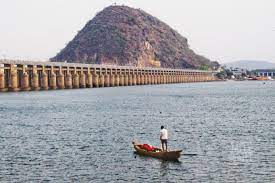
At Vijayawada, a weir controls the flow of the river into a system of canals in the delta, which are used for irrigation. Britannica notes that the river is not navigable. The Tungabhadra dam at Hospet, completed in 1957, forms a reservoir and supplies hydroelectric power, and there are other hydroelectric installations at Srisailam and Nagarjuna Sagar on the Telangana-Andhra Pradesh border.
The river provides irrigation water to Maharashtra, Karnataka, Telangana and Andhra Pradesh.
Religious Importance and Krishna Pushkaram
The river is revered as sacred by Hindus, and it is believed that bathing in it removes sins. The riverbank is lined with ghats along the stretch of the river. The river bears the name of Lord Krishna. Krishna Pushkaram, the river’s festival, is held once every twelve years for twelve days, from the time Jupiter enters Virgo (Kanya rasi); pilgrims bathe at ghats in places such as Vijayawada and Srisailam. The Andhra Pradesh government announces the exact dates of each Pushkaram, so check the official announcement before planning a visit.
A common saying in Marathi, which translates as “quiet and slow flows Krishna”, is ironic given the river’s size and the speed of its monsoon flow.
Also Read Place To Visit In And Around krishna District
